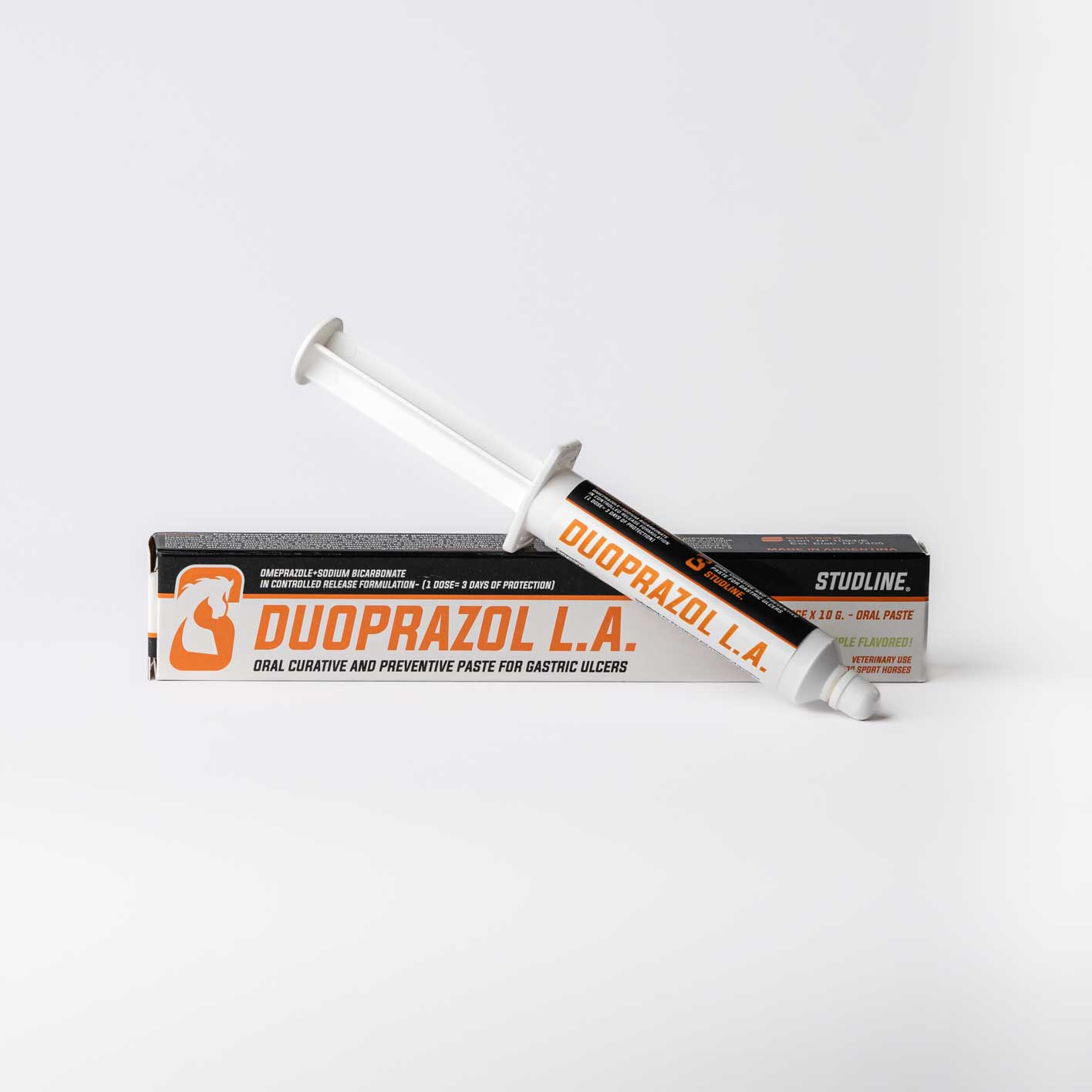
DUOPRAZOL L.A.
DESCRIPTION:
DUOPRAZOL L.A. has a unique formulation that allows 3 days of protection, thus reducing the work of the caregivers and the discomfort to the animal. The formulation has two active ingredients: Omeprazole -a proton pump blocker in a controlled release formulation- and Sodium Bicarbonate – which neutralizes excess stomach acid while allowing the Omeprazole formulation to address the blockage of the proton pump without being immediately inactivated by the acidic pH in the horse’s stomach. At the same time, the excipients facilitate the permanence of the product in the upper digestive tract for a long time, allowing the gradual release of the active ingredients.
DUOPRAZOL L.A. (Omeprazole + Sodium Bicarbonate) for horses contains 225 mg/ml of Omeprazole and is available in a single-dose syringe. Each syringe contains 2.25 g of Omeprazole and 6.75 g of Sodium Bicarbonate. The syringes are designed for a single dose for a 500kg horse. approximately.
COMPOSITION:
Each 100 ml contains:
Omeprazole ………………………………….22.5 g
Sodium Bicarbonate…………………… 67.5 g
Controlled release excipients ……..100 ml.
INDICATIONS:
For the treatment and prevention of recurrence of gastric ulcers in horses and foals 4 weeks of age and older.
DOSAGE:
For the treatment of gastric ulcers, DUOPRAZOL L.A. It should be administered orally once every 3 days, for 4 weeks. As a preventive treatment for horses in high stress conditions, it is suggested to apply a dose (one syringe) weekly.
INSTRUCTIONS FOR USE:
DUOPRAZOL L.A. It is recommended for horses and foals 4 weeks of age and older. The 10 milliliter syringe is designed for horses weighing approximately 500 kg. Both active ingredients have very wide tolerance, such that according to the opinion of the veterinarian, the design dose can be maintained (4.5 mg/kg Omeprazole – 13.5 mg/kg Sodium Bicarbonate) in smaller animals, or apply the entire syringe. To apply DUOPRAZOL L.A. Make sure the horse’s mouth is free of food. Remove the cap from the tip of the syringe and insert the syringe into the horse’s mouth into the interdental space. Press the plunger fully to release the single dose. The dose should be deposited on the back of the tongue or deep in the cheek pouch. Care must be taken to ensure that the horse consumes the full dose. Treated animals should be observed briefly after administration to ensure that no part of the dose is missed or rejected. If part of the dose is missed, it is recommended to redose.
WARNINGS:
Do not use in horses intended for human consumption. Keep this and all medications out of the reach of children. In case of ingestion, contact a doctor. Doctors can contact a poison control center for advice about accidental ingestion. It is recommended that this medication be used by order of a licensed veterinarian. The safety of DUOPRAZOL L.A. in pregnant or lactating mares. Store between 15-25°C.
ADVERSE REACTIONS:
In efficacy trials, at the indicated doses, no adverse reactions were observed.
Clinical Pharmacology
Mechanism of action: Omeprazole is a gastric acid pump inhibitor that regulates the final step in hydrogen ion production and blocks gastric acid secretion regardless of the stimulus. Omeprazole irreversibly binds to the enzyme H+, K+ ATPase of gastric parietal cells that pumps hydrogen ions into the lumen of the stomach in exchange for potassium ions. Because Omeprazole accumulates in the cell canticles and irreversibly binds to the effect site, the steady-state plasma concentration is not directly related to the amount that binds to the enzyme. The relationship between Omeprazole action and plasma concentration is a function of the rate-limiting process of H+, K+ ATPase activity/turnover. Once all the enzyme is bound, acid secretion resumes only after new H+, K+ ATPase is synthesized in the parietal cell (i.e., the rate of new enzyme synthesis exceeds the rate of inhibition). Sodium bicarbonate acts as a protectant for Omeprazole – which is highly labile in acidic environments – and as a pH modifier of the stomach environment, quickly addressing pain and discomfort. Furthermore, the set of excipients shows adhesive characteristics that allow the product to remain as a thin film in the upper digestive tract, thus allowing maximum utilization of the Omeprazole-sodium bicarbonate duo due to its controlled release.
Effectiveness:
Clinical field trials: In an observational study with 10 horses, administered as suggested (i.e. one full 10 ml syringe every 3 days), DUOPRAZOL L.A. cured or reduced the severity of gastric ulcers in all horses treated with Omeprazole. There were no drug-related adverse reactions. In clinical trials, DUOPRAZOL L.A. It was used concomitantly with other therapies including: anthelmintics, antibiotics, steroidal/nonsteroidal anti-inflammatory agents, diuretics, tranquilizers and vaccines. No adverse results or undesirable reactions were found.
Diagnostic and management considerations: The following clinical signs may be associated with gastric ulceration in adult horses: inappetence or decreased appetite, recurrent colic, intermittent loose stools or chronic diarrhea, poor coat, poor body condition or poor performance. Clinical signs in foals may include: bruxism (teeth grinding), excessive salivation, colic, cranial abdominal pain, anorexia, diarrhea, sternal recumbency or weakness. A more accurate diagnosis of gastric ulceration in horses and foals can be made if the ulcers are directly visualized by endoscopic examination of the gastric mucosa. Gastric ulcers may recur in horses if therapy to prevent recurrence is not administered after initial treatment is completed. Although recurrence is not common, it can be used DUOPRAZOL L.A. once a week to control gastric ulcers after treatment. The safety of the administration of DUOPRAZOL L.A. for more than 3 months.
Security: Omeprazole has been well tolerated in both animal and human safety studies, having been tested in animals at more than 20 times the design dose without adverse reactions. In a placebo-controlled tolerance study, adult horses were treated with Omeprazole at a dose of 40 mg/kg/day (26 times the recommended dose of DUOPRAZOL L.A.) for 21 days. No treatment-related adverse effects were observed.
Reproductive Safety: Although Omeprazole and sodium bicarbonate are very safe and studied products, and it is not assumed that they could cause any adverse reaction, no specific studies have been developed in this regard, which is why it is recommended not to use them in pregnant mares unless indicated by a veterinary professional. ®DUOPRAZOL L.A. Presentation: Syringe x 10 g.